

The end of the year can be difficult for many teachers because they are burned out, testing is over so your students are checking out, yet you still have a ton of time to fill. I think the end of the year is the best time to try out new strategies, projects, and games.
Here is a collection of my social studies projects and games that can keep your students engaged until the last day of school.
Build-a-museum: Historical Artifact Activity
Historical artifacts can feel old and stuffy because pottery shards aren’t exciting (to non-historians anyways). But so many things are historical artifacts and it is fun to get students thinking about things in a different way.
This projects is about curating a museum display of historical artifacts and is differentiated for different age groups. Grades 1 – 4 focuses on fun, relatable artifacts from the 20th century. Artifacts are things students know but in 200 years would definitely be a museum artifact.
For grades 5 – 8, students are asked to consider artifacts from the 18th – 20th century. This is an opportunity for students to research actual artifacts and curate their collection (real artifacts or images of them) to tell a story, just like a real museum would. Students engage in research, a timeline activity, and build a presentation.
High school students haven’t necessarily had experience with research so I created a differentiated resource for them. You can choose any time period or culture to focus on depending on your students abilities but for advanced classes, I added a themed museum challenge.
You can choose to build presentations for in-class use or if you need a virtual option, I have a Google Classroom™ option for all grade levels. Click the grade option below and follow links to the Google Classroom™ version if that is what you are looking for.


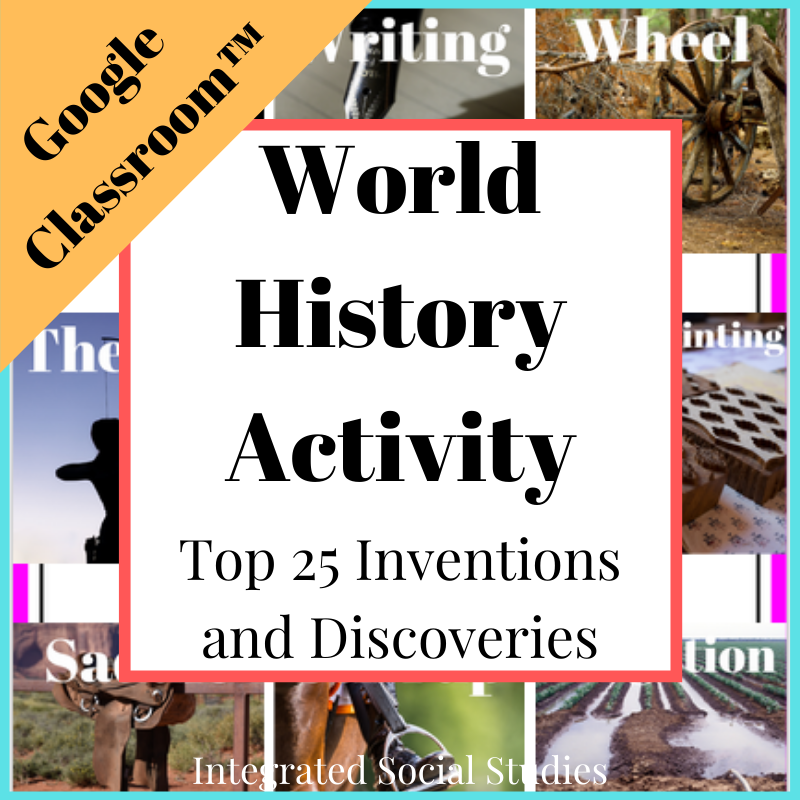
World History Activity: Tournament of Technology Evaluation Activity
This resource was created to help get students talking about history like they do sports (or movies, etc.) The activity is organized like a sports tournament and different inventions and discoveries in world history are paired together. Students will then discuss, evaluate, debate, and then select a winner for each pairing.
There is correct answer. Shuffling the prompts will ensure you don’t repeat the pairings which means students can really begin to develop evaluation skills when it comes to history and they will also work on their conversation/debate/persuasion skills as they try to push through their preferred winner.
I usually write about it as a whole-classroom activity but you could split students into groups and have several different boards in your room. That would be interesting to see and for students to check out their peers boards and decision-making.
For a virtual option and something more developed for an individual learning approach, this resource was rebuilt for Google Classroom™. It is slightly different in that there is no sports bracket but students must rank their top 25 choices in order of importance. Similar concept but it is different.
I think this is a great end-of-year activity because students have learned about all of these inventions and discoveries so the discussions should become quite involved as they become comfortable with the lesson. But I also think this would be fun to do the first week of school, again in the middle, and then by the end, I imagine the discussions would be quite detailed.
These would also be good substitute activities.

Teaching with Chess
So, you’ve wanted to try teaching your medieval Europe unit with chess but it feels too daunting. Or maybe you ware nervous it won’t work or that students won’t like it. Try it at the end of the year.
Sure, you’ve already done the unit but this is a new and fun way to teach it and I promise you that your students will like it. It is unique and hands-on and every student I had loved this unit. It was a fun and different way to learn and a few students told me they began playing chess because of it.
This resource includes a 15-minute streaming video (from the TPT platform) that covers the history of chess and includes information about feudalism. There is a workbook that accompanies the video.
You will need to provide chess boards and pieces and students should be given time to just play the game. Student friendly game instructions are included with your purchase.

Senet: History Game
Senet is the world’s oldest board game (at least for now). We don’t know much about it but the ancient Egyptians wrote about it and left game boards in many tombs. We have the game board and many pieces but no game instructions.
So why not play it in your classroom? There are theories that the game play is similar to other known games which means this resource comes with some game instructions.
The game board was created by me from the game board found in Amenhotep III’s tomb but we have no idea what the symbols mean. The game instructions included have suggested game play so no worries.
This game does require you to prep a little. You will want wooden craft sticks and some game pieces. My favorite game pieces are the little glass flower beads you use in vases. They come in a variety of colors so you can choose your two favorite. They are affordable and students will somehow lose pieces and you will have plenty of extras. But you can use coins, color paper clips, other game pieces.
If I go back to the classroom, I would introduce this resource in the fall and offer a prize to the first student who creates their own game rules using the board. The game should be truly playable and easy to follow. If someone takes the time to come up with something, I would give them a reward of some kind (gift card maybe).

Economics Games
I have three amazing and unique economics resources in my TPT store, one of which is completely original and can only be found in my store.
The first is my store bestseller, Teaching with Monopoly. It can be used in world history classes (as I am a former world history teacher) or economics but I have several reviews from finance class teachers, making this a versatile resource.
This resource requires you to have multiple Monopoly games but it is a lesson your students will never forget and it really does help them learn some economic concepts.
Teaching with Monopoly includes a history of the game presentation, economics, and game piece symbolism (a student favorite), seven unique game scenarios to focus on different economic concepts, and a summary at the end.
Concepts include: mortgages, income inequality, monopolies, and debt.
You can purchase the resource or download the free sample to see more of the resource.

The second economics game I am highlighting in my TPT store is Tulip Mania. This is an original game that teaches your students about auctions, speculation, and financial decision-making. I would bet your students get swept up the mania of the game as well which is perfect for your history lesson about tulip mania, the 17th century economics bubble when tulips were the most expensive commodity in the world.
This a prep-heavy resource but if you take your time to prep all of the pieces, you can keep them for years of classroom use. (I also play this game at home. It is seriously fun.)
There is no better way to get your students to learn and UNDERSTAND auctions and speculation than this game. Get it in my TPT store.

The final economic game in my TPT store is Teaching with Pit. My mother loves this game and I played it several times growing up and I always remembered it. The game itself is fun but when I began teaching, I recognized the teaching moments the game presents.
Prepare your students with a history of the stock market and Wall Street presentation. Students can participate in market research to introduce them to the markets and what commodities are. If you want your students to complete the research, I recommend booking some time in the library so students have internet access. This research can be completed individually, in pairs, or small-groups. You could even demonstrate how to read the data as a whole-group lesson before setting them on their own.
Finally, students play the game. Let them get swept away with the game play which is the best way for them to connect to the information. Your students will always remember it.
**************************************************
If you liked this then maybe you’d also like:
 Integrated Social Studies
You must be logged in to post a comment.